Calvinball Jurisprudence: Notes on a Court That Forgot the Rules
The current Supreme Court isn’t conservative. It’s outcome-driven — and the difference is the whole story.

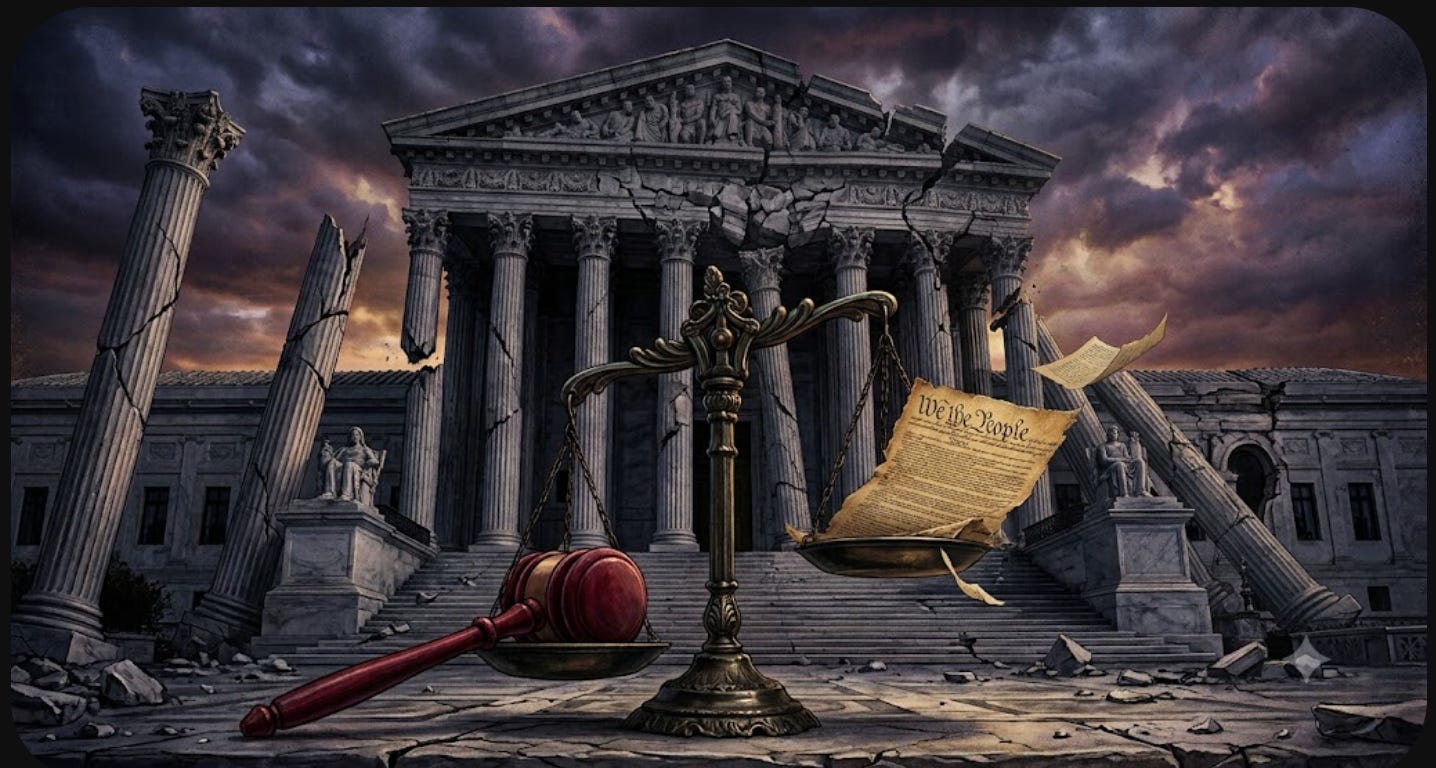
There’s a useful phrase buried in a Ketanji Brown Jackson dissent from earlier this year, written after the Court let the administration gut funding for the National Institutes of Health on the shadow docket. She accused her colleagues of practicing “Calvinball jurisprudence with a twist” — a reference to the Calvin and Hobbes game with exactly one rule: there are no fixed rules. It’s a throwaway line in a footnote of legal history, but it’s also the most precise description available of what this Court actually is. Not conservative. Not originalist. Not textualist. Outcome-driven, with the methodology assembled after the fact to fit the result.
This isn’t a new complaint — every losing side in every contested ruling thinks the winners cheated. But there’s a difference between disagreeing with a court’s conclusions and watching a court abandon its own stated rules of the game mid-play, term after term, in a single direction. That’s not jurisprudence. That’s a result in search of a rationale.
The Win That Wasn’t
The clearest illustration landed this week, in the case everyone is calling a defeat for the administration: the birthright citizenship ruling. On its face, it looks like the system working — the Court rejected Trump’s executive order purporting to end automatic citizenship for children born to undocumented or temporary-visa parents, an order so far outside legal consensus that every lower court to review it called it “blatantly unconstitutional.” Chief Justice Roberts wrote a careful, historically grounded opinion tracing the 14th Amendment back through Wong Kim Ark, English common law, and the Reconstruction Congress’s deliberate repudiation of Dred Scott. Crowds cheered outside the building.
Look at the vote structure, though, and the story gets uglier. On the bottom-line outcome — order struck down — it was 6-3. But on the actual constitutional question — does the 14th Amendment guarantee birthright citizenship as a matter of constitutional text, full stop — it was 5-4. Roberts’ opinion holding that it does was joined by the three liberal justices and, alone among the Court’s conservatives, Amy Coney Barrett. Brett Kavanaugh wouldn’t sign on. He wrote separately that the order doesn’t violate the Constitution at all — in his reading, the text is genuinely silent on the question — but does violate an existing federal statute, one Congress “could amend” if it chose to. Thomas, joined by Gorsuch, filed a 91-page dissent insisting the majority’s history is fabricated. Alito called the decision “a serious mistake” in his own opinion.
So the actual headline isn’t that the Court protected birthright citizenship from a lawless executive order. It’s that four sitting justices believe the question is close enough that an ordinary Congressional majority — not even a constitutional amendment — could undo a citizenship guarantee that has stood since 1898. A “win” that requires the Chief Justice to construct a from-scratch historical argument just to hold a one-vote majority on settled law is not evidence of a court anchored in precedent. It’s evidence of how far the anchor has already slipped.
The Same Week
What makes this legible as a pattern rather than an outlier is that the birthright citizenship ruling didn’t arrive alone. It landed in the same 48-hour window as several other decisions closing out the term, and the company it kept tells you more than the case itself does.
A day earlier, the Court overturned Humphrey’s Executor, a 91-year-old precedent that had let Congress shield independent agency heads — FTC commissioners, Federal Reserve governors, FCC and FEC leadership — from removal at presidential will. The 6-3 ruling let Trump’s March 2025 firing of FTC Commissioner Rebecca Slaughter stand and, more importantly, stripped a structural check that every president since FDR had operated under. The Court stopped just short of extending the same logic to the Federal Reserve, a 5-4 split with Kavanaugh joining Roberts and the liberal bloc — itself a tell about how unstable the new rule is, since the justices apparently couldn’t agree on how far their own holding should reach.
The same sitting also delivered a ruling upholding state bans on transgender athletes in girls’ and women’s school sports, and a separate decision stripping federal courts of authority to review the Department of Homeland Security’s cancellation of Temporary Protected Status for hundreds of thousands of Haitian and Syrian immigrants — removing a judicial check on executive immigration power in the same week the Court loudly reasserted judicial authority over a different immigration order. And in a campaign finance case, the Court struck down longtime limits on coordinated spending between national parties and candidates, prompting a dissent from Justice Kagan warning that the ruling reopens the door to the kind of quid pro quo arrangements those limits were built to prevent.
Read individually, each case has a defensible legal story. Read together, in the space of three days, they describe a single throughline: executive power expands, judicial and Congressional checks on that power contract, and individual rights survive only when the specific right in question happens to align with the majority’s priors. Birthright citizenship is a constitutional guarantee dating to Reconstruction; it barely survived. Coordinated campaign spending limits dated to the post-Watergate era; they didn’t.
Methodology as Costume
None of this requires conspiracy theorizing, because the Court has been telling on itself in public for years. The “major questions doctrine” — the idea that agencies need explicit Congressional authorization for anything of significant economic or political consequence — appears when the agency in question is the EPA or OSHA, and quietly disappears when the question is whether a president can fire a Fed governor or impose tariffs under emergency powers never previously read that broadly. Originalism produces an expansive reading of executive authority in Trump v. United States (presidential immunity for official acts, 2024) and a narrow, history-soaked reading of the right to abortion in Dobbs (2022) — as though the framers were maximalists about Article II and minimalists about the Ninth and Fourteenth Amendments specifically.
The shadow docket is the clearest tell of all. Democracy Forward’s tracking shows the second Trump administration filed 28 emergency applications with the Court in roughly its first eight months back in office — a continuation of an escalation that started in Trump’s first term (41 applications across four years, against a combined eight from the Bush and Obama administrations over sixteen years). The shadow docket exists for genuine emergencies. It has become the preferred vehicle for deciding consequential, ideologically charged questions without full briefing, oral argument, or a reasoned opinion — exactly the kind of “no fixed rules” governance Jackson’s dissent was naming.
What a Court of Law Would Look Like
It’s worth being precise about the counterfactual, because the point isn’t that courts should never overturn precedent or that “conservative” and “illegitimate” are synonyms. The Warren Court was unmistakably activist in the literal sense — it expanded rights aggressively, fast, and against considerable political resistance: Brown, Gideon, Miranda, Loving. What distinguished it wasn’t restraint; it was direction and consistency. It expanded the franchise of who counted as fully protected under the Constitution, and it applied a recognizably stable method to get there.
What’s different now isn’t the willingness to break precedent — Brown broke precedent too. It’s that the current Court’s breaks point almost uniformly toward concentrating power in the executive and contracting it everywhere else: away from voters (Shelby County, gutting Voting Rights Act preclearance), away from agencies acting on Congressional authorization (Loper Bright, ending Chevron deference), away from the right to bodily autonomy (Dobbs), away from the people Congress designed independent agencies to insulate from political control (Humphrey’s Executor, just this week), and toward corporate political spending (Citizens United, and now the coordinated-spending ruling) and an unaccountable presidency (Trump v. United States). A court of law, applying a stable method, would scatter its outcomes across the ideological map in proportion to where the law actually points. A court of ideology produces a pattern. This Court produces a pattern.
The Demon’s Job
I’ve written before about the Maxwell’s Demon principle as a frame for living deliberately against entropy — sorting, filtering, refusing to let disorder accumulate just because it’s the path of least resistance. Courts are supposed to be one of the few institutional demons we have: the place where drift gets sorted back toward principle, where the hot molecules of political will get filtered out from the cold logic of constitutional text. What we have instead is a Court that has stopped sorting and started accelerating the very entropy it exists to resist — not randomly, but in a direction. That’s the part that should worry anyone who still thinks “rule of law” describes something other than whoever currently holds five votes.
The system isn’t broken in the sense of malfunctioning. It’s working exactly as designed by people who spent forty years building a pipeline — the Federalist Society judicial selection process, the deliberate cultivation of a conservative legal movement with its own law reviews, clerkship networks, and feeder judges — to produce precisely this outcome. The Calvinball isn’t a bug. It’s the load-bearing feature. And recognizing that is the first step toward understanding that the fix isn’t going to come from inside the institution that benefits from the current rules of no rules.