Comrade Alpha
On the manufactured masculinity of the dittohead, and why the New Soviet Man is the better comparison than the fascist one

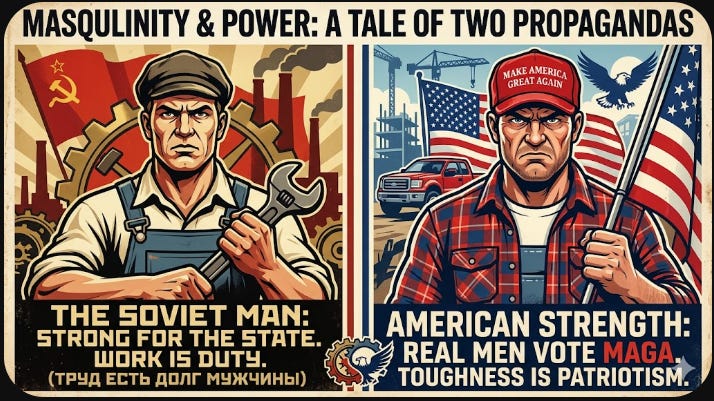
There is a particular kind of man who needs to tell you he is an alpha male. He posts it. He podcasts it. He builds a supplement company around it. He explains, at length and unprompted, that he sits at the top of a dominance hierarchy, the way a genuinely wealthy person never opens a conversation by mentioning his net worth. The announcement is the tell. A real apex predator does not issue a press release.
I want to take the spectacle seriously, though, because it isn’t just personal insecurity wearing a tactical vest. It’s propaganda — engineered, distributed, and politically load-bearing. And the most useful thing I can do with it is resist the obvious comparison.
The lazy move is to reach for fascism. Mussolini stripped to the waist in the wheat fields. The Nazi body cult, the marble supermen, the whole aesthetic of the hardened male as living evidence of national vitality. It’s right there, and it’s why most people stop at it. But the fascist comparison has gone slack from overuse, and more to the point, it’s the wrong machine. The American right doesn’t rhyme with fascism so much as it rhymes, structurally, with the thing it spent fifty years claiming to oppose.
The New Soviet Man
The Soviet Union manufactured an ideal man on purpose. They even had a name for him: novy sovetsky chelovek, the New Soviet Man. He was disciplined, robust, selfless, physically hardened, and above all devoted. The state produced him the way it produced tractors — as output, to spec.
The cult had its pin-ups. Alexei Stakhanov, the coal miner who supposedly cut fourteen times his quota in a single shift, became a poster, a movement, a verb. Stakhanovites were the productive supermen of the workers’ paradise, and their virility was inseparable from their loyalty. The fizkultura parades marched sculpted worker-athletes through Red Square as a kind of biological argument: look at these bodies, look what the system grows.
And the enemy was always coded as soft. The flabby top-hatted capitalist, drawn with a cigar and a swollen belly. The rootless cosmopolitan. The decadent bourgeois who had gone weak on comfort and lost the capacity for real work. The political opponent wasn’t merely wrong. He was unmanly, and his unmanliness was offered as proof of his corruption.
If that last part sounds familiar, it should. The manosphere’s entire bestiary runs on it — the soyboy, the seed-oil consumer, the beta who has let himself be domesticated and feminized, the liberal man as a creature who has been kept. Same grammar exactly: the enemy is soft, softness is degeneracy, and a degraded body is the visible receipt of a degraded politics.
The machine, not the content
Here is why authoritarian movements keep building this same idol, century after century, on opposite sides of the economic spectrum. Manufactured masculinity does three jobs at once, and it does them regardless of ideology.
It hands humiliated or anxious men a story in which their dignity gets restored. It fuses personal virtue with loyalty to the regime, so that being a real man and being a loyal man collapse into a single act. And it installs a disciplinary norm in which any deviation reads simultaneously as weakness and as betrayal. The body becomes a loyalty oath you wear in public.
That toolkit is ideology-agnostic. It bolts just as cleanly onto collectivism as onto individualism, which is the whole point. The structure is the product. The content is interchangeable fuel.
“Rugged individualists,” or, the dittohead problem
Now, the obvious objection. Wasn’t the Soviet man a collectivist? His hardened body served the state; his labor was sacrifice for the common project. And isn’t MAGA masculinity the photographic negative of that — hyper-individualist, entrepreneurial, the grindset, the personal brand, the alpha as a lone winner who answers to no one?
That’s what they sell. It is not what they are.
“Rugged individualism” is brand, not behavior. The lived reality of the movement is the thing one of its own founding broadcasters named for it. Rush Limbaugh called his audience dittoheads — and they wore it proudly, calling in to say “ditto,” meaning I agree, I need add nothing, I am with you completely. That is the actual organizing principle: synchronized outrage, identical talking points surfacing in a thousand mouths within a single news cycle, a culture in which the supreme virtue is loyalty and the supreme sin is independent deviation.
So the individualism isn’t real, but it isn’t nothing either. It’s a costume, and the costume is doing work. The New Soviet Man also thought of himself as the heroic agent, the vanguard, the one driving history — even as he was the most regimented man alive. The self-image of autonomy was part of the propaganda. That’s the precise trick here too. The alpha mythology sells “I bow to no one” to men whose daily practice is bowing in unison. It is conformity that has learned to market itself as rebellion, obedience cosplaying as command. Which makes it a tighter fit for the Soviet comparison, not a looser one. The machine is the same. It has simply gotten better at flattering its own components.
A necessary distinction
Let me cut off the bad-faith reading before it boards. None of this is an argument that lifting weights is fascist, or that a man who wants to be strong and capable is a propaganda victim. Masculinity as a private pursuit — discipline, fitness, competence, the desire to be useful and unafraid — is a perfectly good thing to want, and it predates every regime that ever tried to weaponize it.
The argument is narrower and sharper than that. It is about masculinity that has been manufactured by a political project and turned into a loyalty test — where your body is no longer yours but evidence submitted on behalf of the cause, and where the man across the aisle isn’t an opponent to be argued with but a soft, degraded organism to be despised. The gym is innocent. The state that wants to grade you on it is not.
Dad in a pen
And now the part that should make the whole alpha edifice collapse on contact, because it’s true and almost nobody knows it.
The “alpha wolf” doesn’t exist. Or rather, it was an artifact of bad conditions, and the science abandoned it decades ago. David Mech — the wolf biologist who, more than anyone, popularized the alpha-wolf concept in the first place — spent the rest of his career trying to kill it. The original observations came from wolves crammed together in captivity, unrelated animals forced into a pen, where the stress produced a brittle dominance order. Then researchers went and watched wild packs. What they found wasn’t a hierarchy of competing males clawing for the top spot. They found a family. The “alpha” is simply the breeding parent. The pack is his offspring. The alpha wolf is dad.
So sit with what the self-declared alpha male is actually doing. He has modeled his entire identity on a behavior that only shows up in stressed animals confined against their will — and that the field that coined the term threw out once it looked at animals living free. He isn’t emulating a king of the forest. He’s emulating a captive under pressure, performing a dominance that nature never asked for, advertising a rank that, in the wild, just means I am somebody’s father.
Which brings us back where we started. Anyone who has to tell you he’s an alpha male is announcing two things at once. The first is that he isn’t one. The second, and the more damning, is that he’s a dittohead in a costume — a man performing solitary dominance in perfect synchrony with ten million others performing the exact same solitary dominance, all of them certain they answer to no one, all of them saying ditto.
The New Soviet Man would have understood him completely. Different fuel. Same machine.
Kevin M. Cowan is a writer, musician, filmmaker, and technologist who has spent a career crossing borders — between continents, disciplines, and decades. His documentary work has screened at festivals across four continents, his novels and short stories explore what it means to declare yourself human, and he builds AI systems for a living. He plays drums and sings in Food for Robots. The throughline across all of it is the same stubborn question: what do we bring with us into the future, and what do we leave behind? He calls himself an Analog Futurist. He lives in the mountains of Colorado and writes at kemico.substack.com.