The Pool and the Precedent
Why the National Guard protecting the toxic incompetence of Trump's Reflecting Pool fiasco and the so-called "War" on (some) Drugs are the same machine.

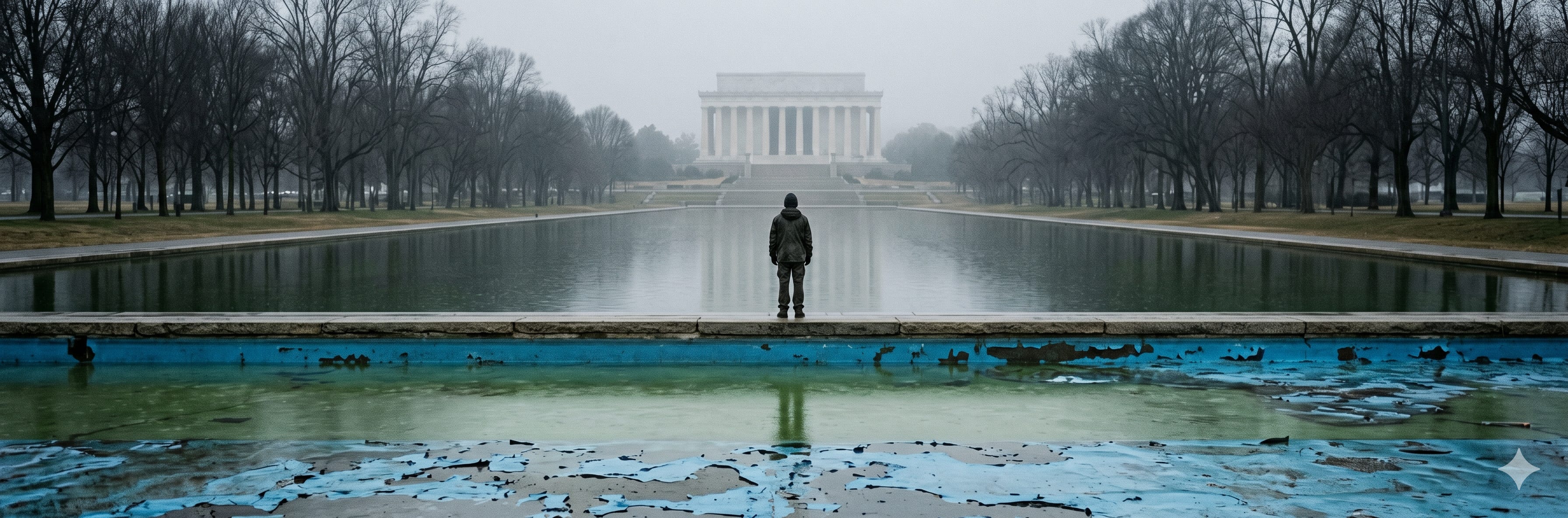
The Lincoln Memorial Reflecting Pool is currently green, peeling, and embarrassing. It cost somewhere between $14 and $16 million, depending on which official number you catch on which day, and it was supposed to be blue — a specific Trump-ordered “American flag blue” — in time for the 250th anniversary of the Declaration of Independence. Instead it looks like a neglected aquarium, and strips of the new liner are floating off the bottom like dead skin.
This is not a political opinion. This is what reporters and tourists have been documenting with their phones for days. It is also, to be precise, exactly what aquatics engineers and pool science experts said would happen when an administration that treats expertise as elitism decided to skip the consultation and move fast.
The warnings were on record. The anti-science disposition that has become a defining feature of this political movement does not make algae grow slower or liner adhesion stronger. Nature is not ideologically persuadable.
What happened next is more instructive than the renovation failure itself. Rather than acknowledge a contractor problem covered under warranty, the administration deployed a narrative: vandals. Radical left lunatics. Corrosive chemicals. A 250-foot gash. All asserted, none evidenced. And to anchor the story, they needed an arrest. They got one in David Hearn — a 67-year-old three-time Olympian who stopped at the pool after a 52-mile bike ride, noticed a piece of liner that was already detached from the bottom, reached in and touched it, was told by a park worker to stop, and let go. He was then surrounded by National Guard troops, taken into custody by Park Police, held for five hours without a phone call, and charged with destruction of government property. He is now receiving death threats.
The charges will likely evaporate. That’s not the point. The point is that the apparatus moved, and it moved fast, and it moved against a man whose crime was scientific curiosity about a failing public works project.
Here’s where I want to take a breath and make a point: many people are experiencing something for the first time that a much smaller group of Americans has known intimately for decades.
The Tie-In: Authoritarianism comes for everyone now
The so-called “war” on (some) drugs — and I will insist on those quotation marks, because it was never a war on drugs. It was always a war on certain people who used certain drugs. It operated on exactly this same architecture. It is worth noting, first, that you cannot legally or logically declare war on an abstraction. A war requires an enemy state, an enemy combatant, a definable military objective. “Drugs” is none of those things. The “war” framing was always a rhetorical device — a way to invoke emergency powers, suspend normal constitutional scrutiny, and pass legislation that would have otherwise failed the Fourth Amendment on its face. And it did fail the Fourth Amendment, repeatedly and deliberately, while courts tied themselves in knots to accommodate it because the word “war” was doing political work that legal reasoning couldn’t support on its own.
But the lived experience of that period was not primarily about courtrooms. It was about waking up every morning knowing the state had decided your lifestyle choices made you a criminal. It was the constant calculus of who you could talk to, who you could be seen with, what you said on the phone, who was in the room. It was understanding that association itself was evidence — that your friends’ choices could become your legal liability. It was knowing that even if you were careful, even if you were clean, even if you did everything right, you could still end up on a watch list because someone somewhere needed to justify their budget or make a quota. Millions of people — disproportionately Black, Brown, poor, and young, but not exclusively — had their lives permanently destroyed. Not by violence. Not by addiction. By prosecution. By a criminal record that foreclosed employment, housing, voting rights, and futures, handed down for non-violent choices that harmed no one.
And now it’s happening to the entire nation…well, except for the billionaires, of course.
It Has Always Been About Selective Enforcement
The enforcement has never been consistent, which was precisely the point. The same quantity of the same substance meant five years in one state and a citation in another — unless someone decided to call it distribution, at which point it was a decade or more, regardless of context, regardless of intent. Discretion wasn’t a bug in the system. It was the system. Arbitrary power dressed up as law enforcement.
If Only There Were Some Way To Foresee
I am not optimistic by default. I’ve watched too many “this time people will finally understand” moments dissolve back into the ambient noise of comfortable disengagement. But there is something different about this particular sequence: the failure is visible, the incompetence is documented, the arrest is on video, and the person arrested is a white 67-year-old former Olympian in lime green cycling gear who was on a bike ride. The machinery usually operates on people with less cultural insulation. This time it didn’t bother.
What the war on drugs taught, to those who were paying attention, is that the machinery doesn’t care about guilt. It cares about utility. An arrest is a message. Sometimes the message is we are in control. Sometimes it’s don’t look too closely at what we broke. The charges against David Hearn are almost certainly the second kind.
The pool is still green. The liner is still peeling. The contractor has confirmed it needs to be drained again.
And non-violent recreational drug users are still having their privacy invaded, their associations surveilled, and their lives systematically destroyed under the authority of a legal framework built on a fiction — a declared war against an abstraction, sustained for decades because too few people with comfortable lives were paying close enough attention to care.
None of this is going to stop being true because someone got arrested for noticing it.
None of it stops at all until We, the People insist — loudly, consistently, and at the ballot box — that our elected officials and the enforcement apparatus they control are bound by the Constitution, the Bill of Rights, and every amendment to them. Not selectively. Not when convenient. Not when the target is someone sufficiently unlike us to make the violation feel abstract.
We are supposed to be a constitutional republic operating under the rule of law. It is past time we started acting like one.
Kevin M. Cowan is a writer, musician, filmmaker, and technologist who has spent a career crossing borders — between continents, disciplines, and decades. His documentary work has screened at festivals across four continents, his novels and short stories explore what it means to declare yourself human, and he builds AI systems for a living. He plays drums and sings in Food for Robots. The throughline across all of it is the same stubborn question: what do we bring with us into the future, and what do we leave behind? He calls himself an Analog Futurist. He lives in the mountains of Colorado and writes at kemico.substack.com.